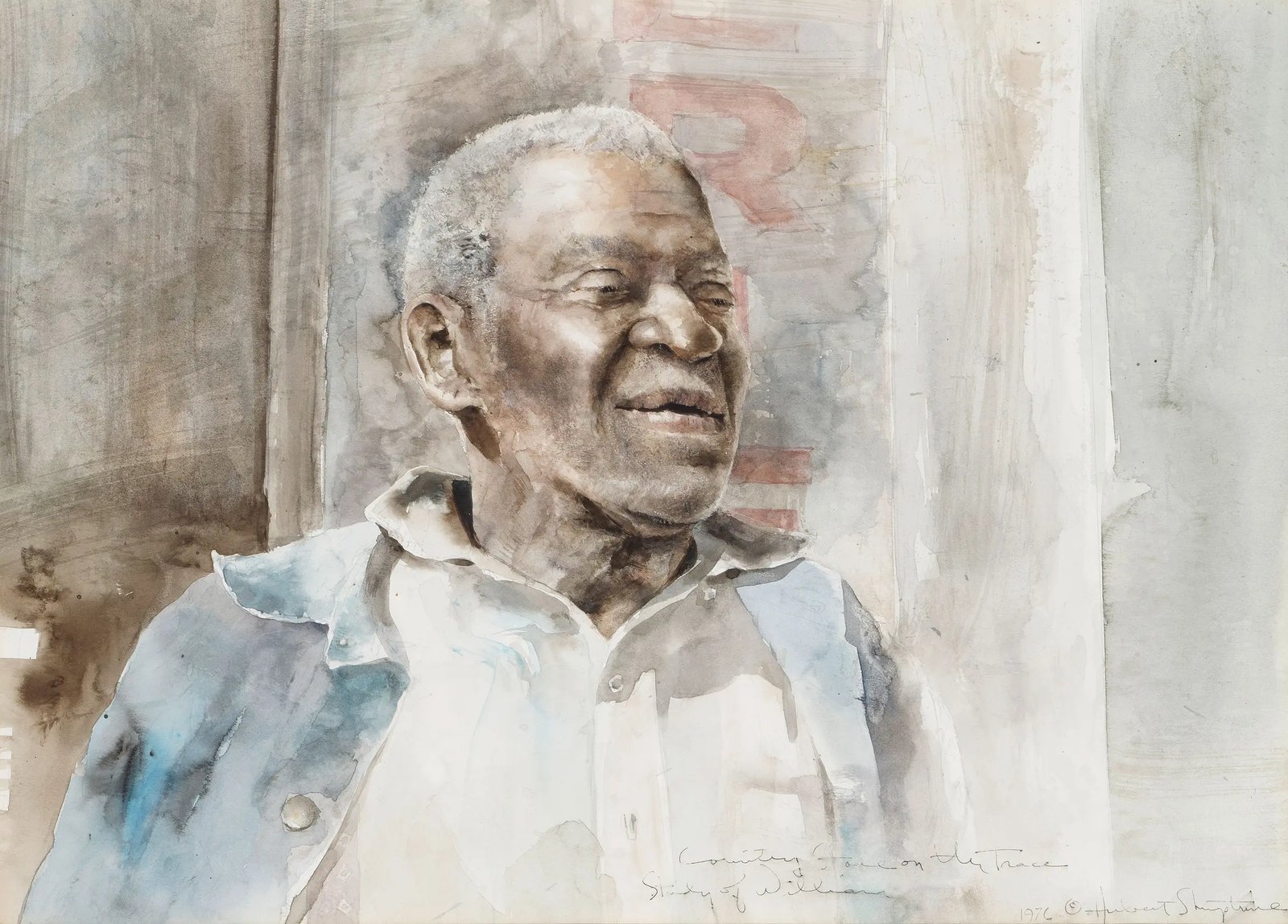
Chattanooga, Tennessee · 1936–2006
Hubert Shuptrine
The South Beheld · A Living Archive of the Artist of Jericho
Scroll to open the book ↓
The South Beheld · A Living Archive of the Artist of Jericho
Scroll to open the book ↓
James Dickey — poet, novelist, author of Deliverance — wrote those words about a self-taught watercolorist from Chattanooga who drove fifteen thousand miles of Southern back roads to paint the people the century was leaving behind. This archive gathers what is known of Hubert Shuptrine: the life, the books, the sitters, the craft, and the family who carry the brushes now.
Nature, People, and Memory in the Watercolors of Hubert Shuptrine
Drawn from museum records, curatorial essays, auction archives, the two Jericho books, and the living memory of the Shuptrine family — assembled as the research foundation for a forthcoming biography, and presented here as a photobook in his honor.
“Never make history more dramatic by making it less true.”
Everything in this archive is drawn from cited, checkable sources — museum curators, vital records, auction archives, newspaper coverage, and the artist's own published words. Where a claim rests on family tradition alone, it is presented as exactly that. Several family legends have already been tested against the record: some proved truer than the paperwork (the famous cousin in the Smoky Mountains is real), and some proved taller (the million-copy legend). Both findings serve the same master: the truth. The goal is a record Phyllis Shuptrine Best can read, correct, and sign.
Verified first. Legend second. Nothing invented.
Hubert Shuptrine was born in Chattanooga, Tennessee, on March 21, 1936, and died in the same city seventy years later, on April 7, 2006. Between those dates he did something deeply unfashionable: at the height of the modernist era, he abandoned abstract oil painting for tightly controlled watercolor realism, and devoted the rest of his life to the people, traditions, and landscapes of what he called the vanishing South.
He called his finished works not realism but “realizations” — each one an attempt to render, in a single face or a single weathered room, “the sum of moments — past, present, and future, infused into a single glance.” His sitters were mountain elders, Cherokee craftspeople, Gullah basket makers, sharecroppers, and one famous centenarian banjo player in Thompson's Cove, North Carolina.
His 1974 book Jericho: The South Beheld, with text by James Dickey, set sales records in art-book publishing and made him a national figure. Its 1987 sequel, Home to Jericho, extended the project across fifteen states. Tennessee gave him its highest arts honor in 2005. Then, for a time, the world largely forgot. This archive — and the book it feeds — is the remembering.
Horses, vet school, abstraction, the Bahamas — and a vacation in Maine that changed everything
Hubert Oliver Shuptrine, Jr. was born to Hubert O. Shuptrine Sr. and Myrtis Alderman Shuptrine, Georgia farm people transplanted to Chattanooga. He was a precocious child who loved two things: drawing, and horses. At Chattanooga's Central High School — class of 1954 — he played trumpet, was named Class Poet, and heard his art teacher, Mrs. Derryberry, tell him he would never make it as an artist.
The pull of the stable was strong enough that he enrolled at the University of Tennessee in Knoxville to study veterinary medicine. The hinge of his life was a chance glimpse through a doorway: a studio art class in progress. He changed his major and his school, transferred home to the University of Chattanooga — where the trustees' 1959 minutes record “Hubert Oliver Shuptrine — Art” — led the ROTC military band, and married Phyllis Wright in 1958, over her mother's objection that an artist had “no prospects… to support a wife.”
Before the degree was a year old came the Army: two years as an officer in the Quartermaster Corps at Fort Lee, Virginia. In 1960 his father died. Through most of the decade came what the family obituary calls “several jobs in the visual arts industry” — the commercial apprenticeship of a painter who had not yet found his subject.
Through the 1960s Shuptrine worked in oil and acrylic as a semi-abstract expressionist, winning regional and national awards. In 1963 — possessed, in the family gallery's telling, by a passion to see the turquoise waters where Winslow Homer had painted — he moved his family of five to the Bahamas. He returned to the States in 1966, increasingly drawn to the Eastern Seaboard and the coast of Maine, and began the slow turn from expressionism toward realism.
His public breakthrough came not through dealers but through Plum Nelly, the celebrated outdoor “clothesline” art show on Lookout Mountain, Georgia. Word spread of the artist whose works were “infused with an inner light and extreme attention to detail.” By 1970, the gallery history records, his works were selling out before the gates had even opened — and invitations followed from the Birmingham Museum of Art and the Montgomery Museum of Fine Arts.
The 1957 prize-winner Fish Nets survives as a documented landmark of the abstract period: the Memphis Brooks Museum of Art later deaccessioned it, and it surfaced at auction in 2020 — a rare, provable link to the painter he was before Jericho.
A planned two-week family vacation in Maine stretched into three months. At Prout's Neck, Shuptrine stood in Winslow Homer's studio; he reckoned with Edward Hopper, John Marin, and Andrew Wyeth — the masters who had made watercolor a serious American medium — and there, in his mid-thirties, he taught himself watercolor from scratch.
He was explicit that his ignorance was an asset: “I was fascinated with watercolor. If I had studied it in art school it wouldn't be the same. Most watercolors are very pastel, wet in wet; that didn't seem important to me.” A decade of oils had taught him dense, opaque color; he simply demanded that watercolor do the same.
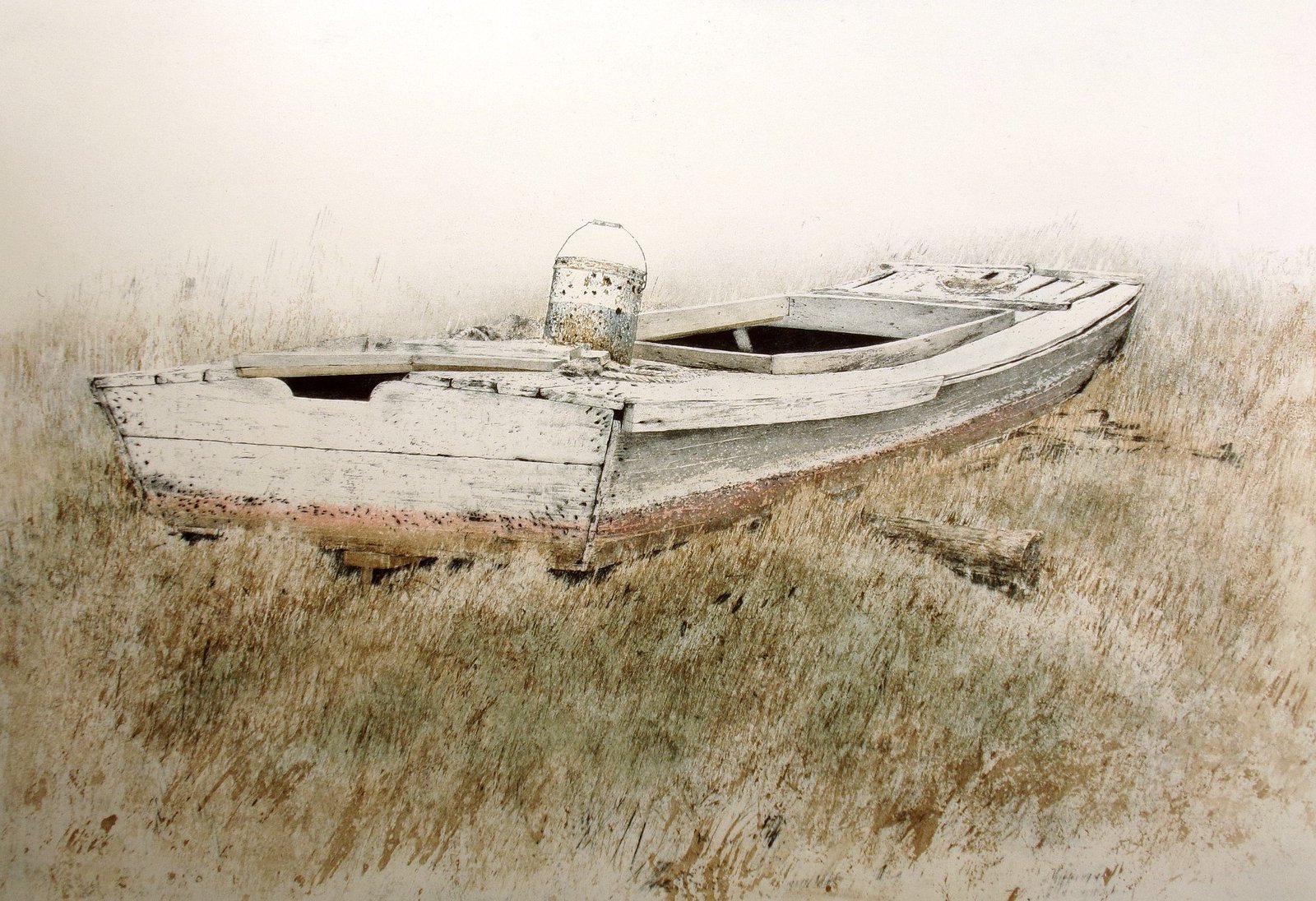
The stay ended with snow. Storms kept the family from getting home to Tennessee, and the last painting of that year was Sea of Snow — a weathered wooden boat alone in a snow-covered field. He came south with a new medium and, soon after, a new home in Highlands, North Carolina. The abstract painter was gone.
“My teachers were (and still are) trial, error, and perseverance. Each completed and signed painting is preceded by several flops, which I think of as lessons learned.”
Fifteen thousand miles · one poet · the book that broke the records
Beginning in the early 1970s, Shuptrine drove more than 15,000 miles of Southern back roads, talking his way into humble dwellings and farmyards. He found he was “not just a painter, but also a preservationist,” racing to depict old farmhouses “before vandals arrived to torch them or progress leveled them.”
His method with people was patience itself. He persuaded sitters to tell him their stories, then sketched while they talked — unselfconscious, relaxed, purposeful. “Once assured that they are being ‘held up to no shame,’ my friends and neighbors will sit for me while I sketch,” he told American Artist in 1973. “The mountaineers are quick to sense insincerity.”
The people he found became the heart of everything after: mountain elders and Cherokee craftspeople, Gullah and Geechee figures of the Lowcountry, children and centenarians. He thought of the results not as portraits but as visual biographies — whole lives compressed into a glance.
The matchmaker was John Logue, a former Atlanta Journal sportswriter who had played tennis with James Dickey since 1961 and now ran Oxmoor House — the book arm of Southern Progress, publisher of Southern Living. In 1974 Oxmoor issued Jericho: The South Beheld: an oblong folio of 165 pages weighing nearly seven pounds, reproducing 101 of Shuptrine's watercolors and pencil drawings, with poetry and prose Dickey wrote in motels across the South. The two men worked separately, with little consultation, yet the result reads as one voice: as the biblical Jericho was the Promised Land, the American South was theirs.
The first edition ran to 150,000 numbered copies — described in the press that December as “the largest first edition of any major art book in the history of publishing” — followed by 25,000 more, at $60 a copy. At the launch signing at Rich's department store in Atlanta, two thousand people stood in line. “Logue,” Dickey told his editor, “we done sat down in the cream jug.”
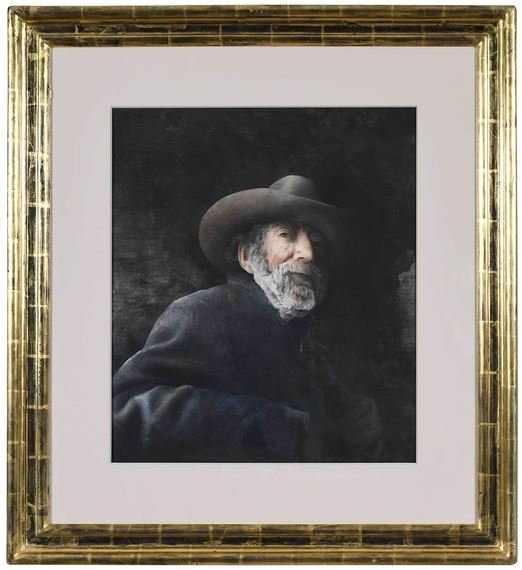
When Shuptrine first saw George Houston Greene, the old man was asleep under an apple tree “like a modern day Rip van Winkle.” Born in Haywood County in 1880, Greene had made weapons in Pennsylvania during the First World War and automobiles in Detroit; when his wife fell terminally ill, he brought her home to their cabin in Thompson's Cove and nursed her until her death. At nearly one hundred he lived without electricity, with water diverted from a stream, cutting his own firewood, growing his own vegetables, in the company of six dogs.
Shuptrine painted him four times; the largest portrait became Sage of the Blue Ridge — pale blue carried through the eyes, the jeans, the beard, the flesh. Greene was a lifelong banjo player; his mother was Rebecca Parton of Sevier County, Tennessee, which makes him Dolly Parton's first cousin, twice removed. When Hubert and Phyllis left his cabin for the last time, the old man raised his hand and said:
“I am a rich man.”
“Experiences etch the human face as if maturing were a divine draftsman's art,” Shuptrine wrote. “Lines and shadows draft biographies I strive to portray. Faces are the great storytellers.” The gallery of sitters below is the heart of the archive — each face a short story he earned on the back roads.
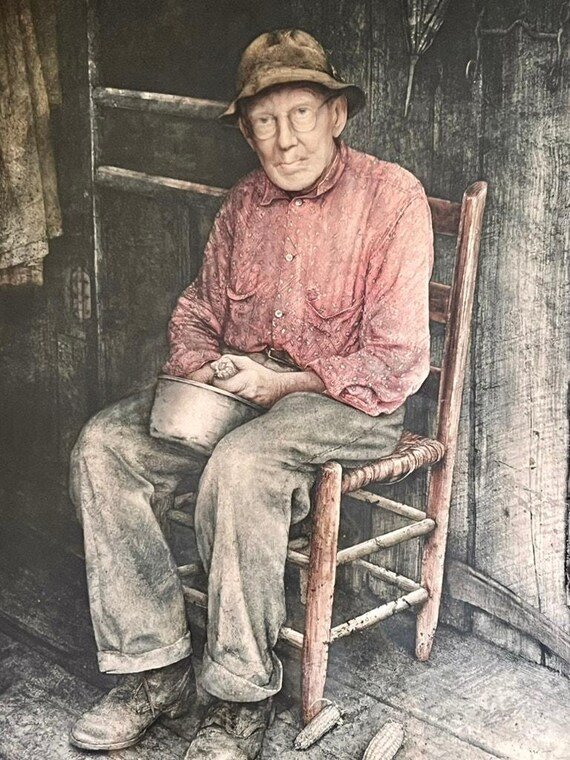
There was Mama Agnes — Agnes Woodward, a former field hand resting on her porch of a Sunday, in red K-mart slippers, Christmas lights entwined with fishing lures overhead. Why hadn't she gone to church with her husband? “Cool, rainy Sunday morning is my church.”
There was Mary Ann Jefferson of the Lowcountry, the sweetgrass basket maker of Sweet Grass — proud of a craft carried from Africa, annoyed that he showed so much of her gray hair. Martha Owl of the Eastern Band of Cherokee, bent over her wampum like a Vermeer. And the silent woman of Red Blood, who posed at the Cherokee powwow without ever speaking a word, and whose name no one on the reservation knew.
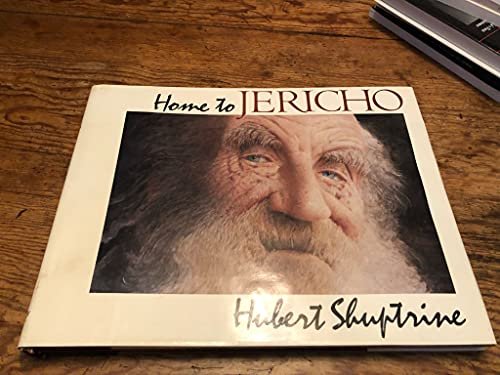
Thirteen years after Jericho, Oxmoor House published the sequel: 159 pages, 90 color plates, in a numbered edition, with a laid-in print of The Roller Mill — and with the text written this time by Hubert and Phyllis Shuptrine themselves, telling the stories of the people behind the paintings. Its scope widened from the Southeast to the backwaters and forgotten places of fifteen states, from Vermont to Texas; the estate records 75,000 copies sold.
Its epilogue is the artist's elegy — the thesis of his whole life's work:
“In the real world, this Jericho is vanishing. There are fewer family farms, fewer rural communities and fewer people interested in a good life, apart from good living. This place of the heart is dying.”
Drybrush, handmade paper, and nine failures in “file thirteen” for every painting that survived
Shuptrine called watercolor painting “chasing rainbows,” and for more than thirty years he undertook to tame what he knew was an evasive medium. Where most watercolorists work in fluid, transparent washes, he tightly controlled the medium until, as the Johnson Collection notes, it resembled tempera — a holdover from his decade as a modernist oil painter.
He achieved his characteristic denseness through drybrush layering and the application of a thickening agent. And he was adamant about materials: “I don't shackle myself with inferior materials and supplies. Handmade paper is my choice, over machine or mold made varieties, and its inconsistency and unpredictability are exciting.”
The cost of that control was failure, at a rate he stated plainly: “I estimate that nine out of ten end up in file thirteen. And some paintings are pure accident.” He persisted, he said, because of “a freshness and an intimacy in a successful watercolor that is possible in no other medium.”
He insisted on precision about the word itself: “The term drybrush has become a misapplied term. Drybrush is a technique of watercolor painting — not a medium in itself. I would define drybrush as a method of drawing or painting in watercolor with tiny strokes.”
Some painters splay the hairs of a sable round to make several strokes at once; that method, he said, did not work for him. “I drybrush with only the point of the brush, sketching and modeling the form as one would sketch with a pencil. This is done over watercolor washes that approximate the end color values desired.”
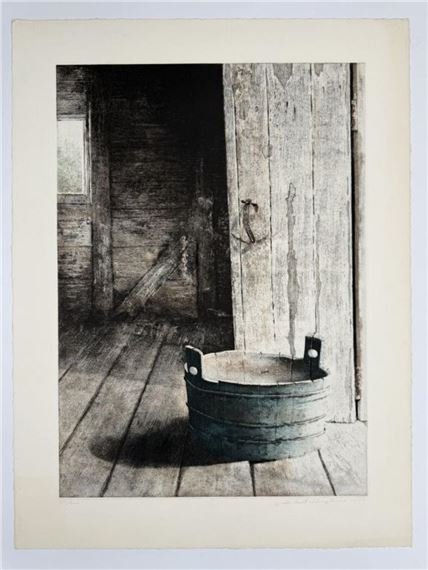
The result — the pattern of creases in a timeworn face, the tiniest strands of whiskers in a bristly beard, the uneven rhythm of weathered boards on a cabin wall — is the texture that makes a Shuptrine recognizable across a room, and the technique he spent his final three months teaching, exclusively, to his daughter Stephanie, with occasional egg tempera added for luminosity.
“I don't think of myself as a realist… I refer to my works as ‘realizations’ because I like the subjective part of painting as much as the objective part. I like to be involved with my subjects so that what I am painting is emotion as much as surface appearance.”
The goal, always: “the sum of moments — past, present, and future, infused into a single glance.”
“All passes. Art alone enduring stays to us.”
The line is the poet Austin Dobson's, quoted by Phyllis Shuptrine Best at the head of the estate's “Renaissance” — the posthumous project of returning Hubert's work to the light. The family who carry it forward are artists themselves.
Phyllis Wright Shuptrine Best married Hubert in 1958 and managed the career so he could paint — and served, for five decades, as his first and most trusted critic. She co-wrote Home to Jericho. Her definition of his work remains the sharpest anyone has offered: “A photograph usually locks a subject into a particular moment… A good portrait is like a biography.” She is now Executrix of the Estate.
Stephanie Shuptrine, the daughter, received what no student ever had: in the last three months of Hubert's life, knowing his time was short, he trained her in the studio in his drybrush watercolor and egg-tempera technique — and asked her to finish the works he would not live to complete. She has titled the resulting collection With My Father's Brushes. She paints today in Brevard, North Carolina; her mother reviews her work by weekly photographs, “just as I had done for her father.”
Alan Shuptrine, the younger son, is a nationally collected watercolorist in his father's realist line and a master water gilder — the restorer the New Orleans Museum of Art called after Hurricane Katrina. He founded Gold Leaf Designs in 1985 and today runs Shuptrine's Gallery on Broad Street in Chattanooga; his own museum exhibition The Serpentine Chain opened at the Tennessee State Museum in 2017.
Randall Shuptrine became a filmmaker and producer. Three children, three disciplines — and between them, the painter's eye runs unbroken into a second generation.
His honors were civic and regional more than academic — the record of a painter beloved by the South he painted. In March 2005, Governor Phil Bredesen presented him the Distinguished Artist Award at the Governor's Awards in the Arts — Tennessee's highest arts honor — in a class that included Booker T. & the MG's and Isaac Hayes. The citation quoted Dickey back at him: an artist able “to make every painting an event to be reckoned with.”
He also held the UTC Distinguished Alumnus Award, commendations from the U.S. Senate and House and the Tennessee legislature, keys to the city of several Southern cities, and listing in Personalities of the South. In 2002 the Greenville County Museum of Art organized a thirty-year traveling retrospective that came home to the Hunter Museum of American Art in Chattanooga; in 2006 the Morris Museum of Art's career retrospective Realizations opened seven weeks after his death.
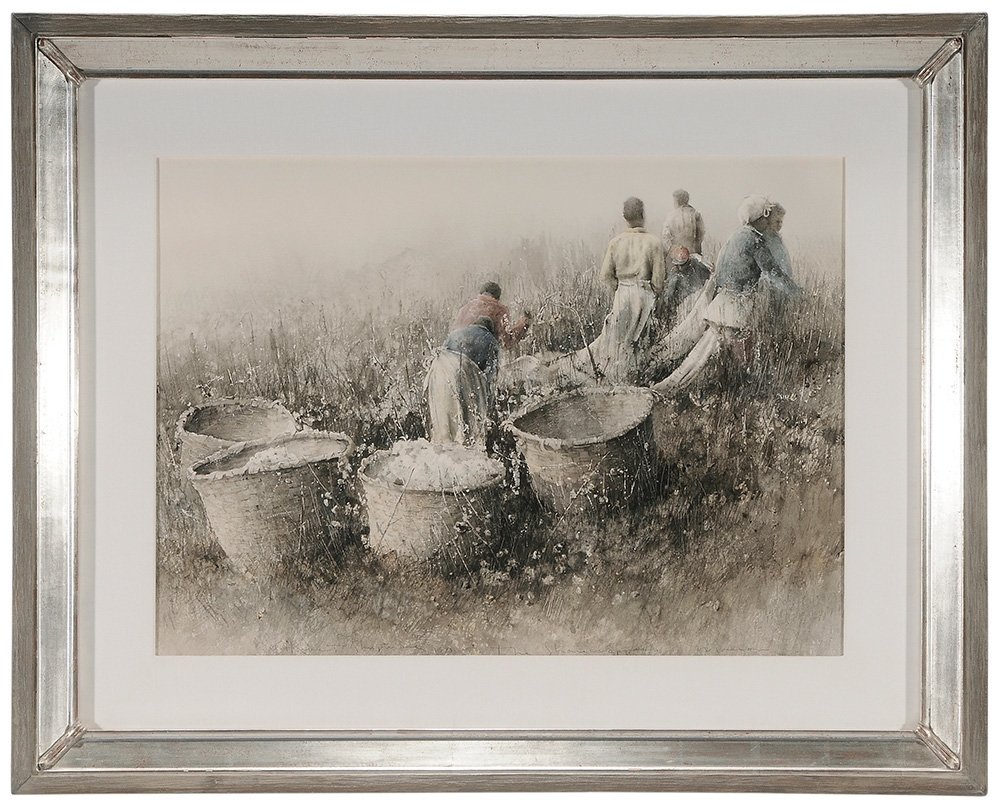
Original watercolors realize roughly $2,500 to $34,000 at auction: the record is Sharecroppers, Marion, Alabama ($34,000, Brunk 2016), followed by the commissioned Portrait of Thomas Jefferson ($23,000, Brunk 2008). John E. du Pont paid $100,000 for his commissioned portrait, The Coach — a price no auction result has matched. The signed lithographs that once retailed for over a thousand dollars now trade in the low hundreds. Appraisers note the structural truth: Shuptrine is identified with a particular region, and regional demand — while deep — caps the national ceiling.
Which is precisely the opportunity this archive serves. The record price — Sharecroppers, Marion, Alabama, $34,000 at Brunk Auctions in 2016 — was set by a painting with a documented place in the Jericho project. Story, documentation, and provenance are what move an artist's market. The remembering is the revaluation.
The estate, under Phyllis Shuptrine Best, has named this effort plainly: “a Renaissance… a new generation of art lovers is discovering a master artist's skills and spiritual discernment.”
This archive rests on the curator Martha R. Severens's 2002 Greenville County Museum of Art essay (built on interviews with the artist in 1997 and 2001); the estate's official site (hubertshuptrine.com), including Phyllis's own 2006 memorial tribute; the Johnson Collection's artist file; University of Chattanooga trustees' minutes; Georgia and Tennessee vital records; museum collection databases (Montgomery, Knoxville, Tennessee State, Johnson Collection); auction records of Brunk, Case, Bonhams, and Invaluable; the Tennessee Arts Commission; the Morris Museum of Art; contemporary Georgia newspaper coverage; and the two Jericho books themselves (Oxmoor House, 1974 and 1987).
Every claim here is being compiled into a fact-check packet for review by Phyllis Shuptrine Best — the widow, collaborator, and first critic — before a word of the biography is set in type. The questions reserved for her are now few and precious: the farewell words of George Houston Greene, the last three months in the studio, and the stories only she was there to see.
The research dossier, the book plan, and the review packet accompany this archive. The book is next.
“Jericho is a fictional locale, but it's real enough. It's a place of the heart.”
The Estate of Hubert Shuptrine · Phyllis Shuptrine Best, Executrix
hubertshuptrine.com · Shuptrine's Gallery, 2613 Broad Street, Chattanooga, Tennessee
MMXXVI · A living archive — compiled with gratitude, verified with care